
Conducting surveys in peak winter, banks that said no, and why government is the ultimate force multiplier. This is a three-part series about the reality of working in the Impact Sector. No prior knowledge of government or public policy is required to read this blog series except the curiosity about how large scale change actually happens.
I want to start this blog with a confession. When I first joined Mission YUVA - a government run program in J&K to promote entrepreneurship - I was skeptical. It wasn’t about the goal of the program. Getting youth to start and run businesses is a great goal. I was skeptical about something more fundamental: ‘Can governments successfully promote entrepreneurship at the grass roots level?’
Here’s the thing about entrepreneurship. It is not a skill that can be learnt. You cannot teach someone ‘How to become an entrepreneur?’ the same way you teach someone to read alphabets. Entrepreneurship is a mindset. It involves taking risks, backing yourself up when everything is uncertain and to keep going when it might be easier to stop. You can’t train people into becoming an entrepreneur. So if the government can’t teach entrepreneurship, what should it do?
I voiced my concern to my team. The same people who have been building the program design along with me. They didn’t dismiss the question but they answered with a framework. Drawing from best practices on entrepreneurship promotion, across the world - they broke down what Mission YUVA actually needed to solve for.
This blog focuses on Culture, Capital and Capacity and how we helped the government address every blocker that was stopping people from becoming entrepreneurs.
First, find the people who are already willing
The most obvious place was to start from Culture and within that, who in J&K already has the mindset to start a business? Because if you cannot create risk-takers from scratch, the next best thing is to identify people from the population who already have that risk taking appetite. We started from there.
So in the months of January and February 2025, during peak Kashmiri winter when temperatures drop to the levels that makes your phone battery discharge faster and your fingers numb, we conducted a baseline survey. It was neither a sample nor a representative study. It was a census level survey covering 1.1 crore individuals across Jammu & Kashmir.
What this looked like on the ground: I wasn’t administering the survey myself. But we were watching the data come in day by day from over 1,000 enumerators who were doing it. They went across every district and corner of J&K, knocking on doors, asking questions, finding out who had the idea, and who had the risk appetite to start something on their own. No private firm would do this. No VC would fund this. Only the government has the reach, the resources, and the mandate to say: “We will survey 1.1 crore people to find out who has the risk taking appetite. Let’s start.”
And here is what that survey produced. Out of 1.1 crore individuals surveyed, we identified 5.5 lakh potential entrepreneurs. These are the people who already have entrepreneurial intent, a business idea, and the appetite to take risk. They became our primary targets. Precise. Data-backed and impossible to find any other way.
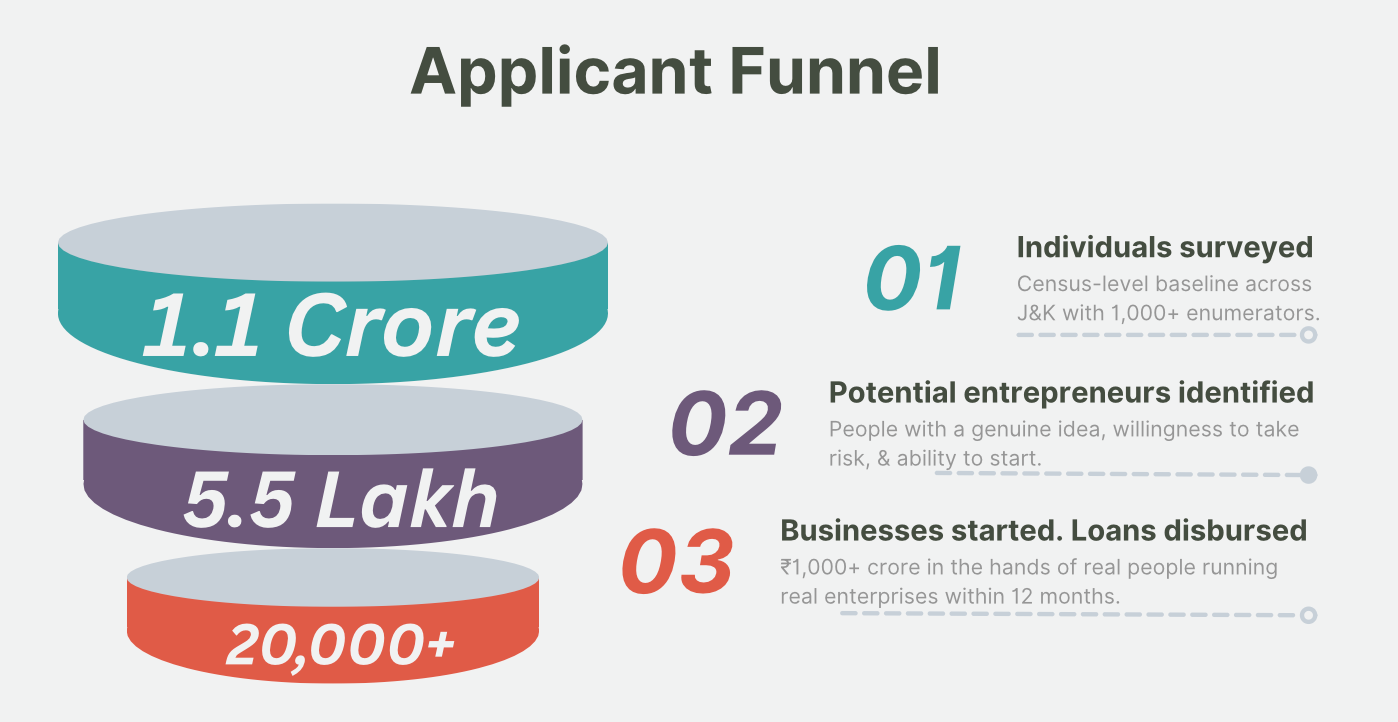
Key Learning 1: Government has the mandate, reach and trust to reach the common man / woman, that no other private firm has. Then, solve every problem between them and their first rupee
Once we knew who was ready, we had to figure out what was stopping them from starting a business. Turns out, there were lots of things.
They didn’t know how to apply for a loan from a bank. They didn’t know how to write a DPR - a Detailed Project Report - which banks require before giving a loan. They didn’t have any support about how to navigate the paperwork that is needed to get a loan. So we recruited and deployed more than 1,000 people to promote the entrepreneurial ecosystem at ground level. These people were posted across blocks and villages. Their job is to find applicants, motivate them, help them prepare their applications, and get their loans disbursed, basically handhold the applicants into becoming an entrepreneur. All this was done in nine odd months.
Then we directed our attention towards banks. At the start of the program, only J&K Bank was willing to participate. And they were worried about lending to first-time borrowers with no credit history as these loan accounts might turn into NPA’s (Non Performing Assets - a loan that is not repaid). They had to follow their own due diligence and there was little scope for us to change bank lending processes. So rather than arguing with them, we introduced a credit guarantee fund. This is how it works: If the applicant defaults, the credit guarantee fund will cover a part of the bank’s losses. This reduced the risks for banks and J&K bank started lending. A second bank - J&K Grameen Bank, has come on board now.
One by one, we removed every blocker. Survey to find risk takers. Teams of people to guide them. Training to equip applicants. Credit guarantee to get support from banks. Each piece was designed to remove a specific friction point between an applicant and their funding.
Key Learning 2: Impact sector problems can be overwhelming. Break down problems into smaller parts and solve them one by one.
One UT. One year. These are not numbers that come from doing things the sarkaari (bureaucratic) way. They come from understanding the limitations of the government and utilizing its strengths.
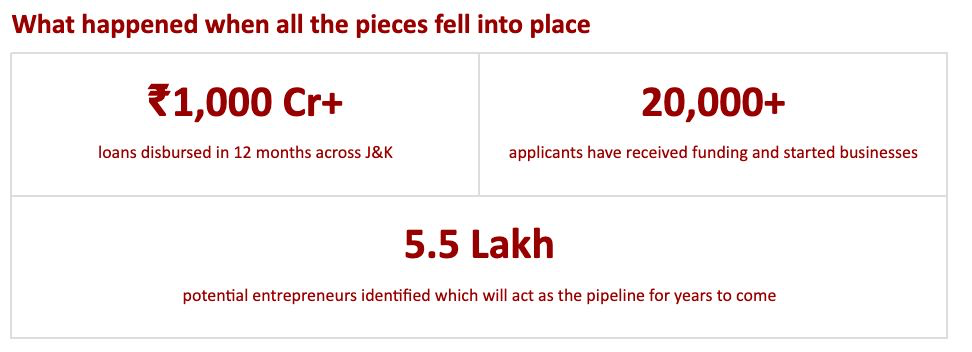
The force multiplier principle
Here is the mental model that I used. We didn’t run Mission YUVA alone. We are a small team. What we did is, we acted as a force multiplier. We designed the systems, built the frameworks, and plugged them into the machinery that the government already has and the government does the rest.
Think about it this way. If you want to change one person’s life in a meaningful manner, be a mentor. If you want to change a thousand, build a great product. If you want to change the lives of a million people, work with the government. Not around it. Not despite it. But with it.
Key Learning 3: Don’t try to be the machinery. Design it, then let the government run it. That’s how a small team moves a million people instead of a few hundred.
THE THING NOBODY TELLS YOU
Before Mission YUVA, I used to think of the government as the place where good ideas get delayed. Now I see it as the most underleveraged distribution network on earth.
The government cannot give someone the courage to start a business. But it can survey 1.1 crore people to find the ones who already have it. It can also deploy a thousand people to handhold someone to set up and run a business. It can guarantee credit so banks say yes.
This division of labour where the government creates the conditions and the individuals seize the opportunity, is not a compromise. It’s by design. And when it works, it produces something no private firm, no VC fund could ever match: entrepreneurship at a large scale.
If you take nothing else from this post, take these:
The government has what no private player has - mandate, reach, and resources: A census of 1.1 crore people, a thousand-strong field force, credit guarantees that move banks. No startup, no NGO, and no private firm has the legitimacy or the reach to pull this off. The government does, by default. Use it.
Break the big problem into small, solvable ones: “Promoting entrepreneurship in J&K” is overwhelming. “Lets find out who wants to be an entrepreneur? (Do a survey), Who will support them? (Hire a team), Do they know how to run a business? (Teach them to run a business), and Banks are not willing to lend (setup a credit guarantee)” are four very solvable problems. Impact sector problems look impossible until you break them down.
Design the machinery, don’t become it: We are a small team. We didn’t do the legwork ourselves. We designed the systems and plugged them into what the government machinery already has. That’s how a handful of people end up moving a million.
Next up in Part 02: But finding people and giving them money is not enough. The real question is: How do you make sure the capacity building you do is actually working on ground and helping people? We built a system that answered both the questions and it worked.