

In 2016-17, Umed Singh was working as a pharmaceutical salesman in Chandigarh, earning around ₹30,000 a month. It wasn't a bad job, but it was far from home, and it wasn't his.
That year, Umed returned to Uttarkashi and set up a small trout unit on family-owned land in Dhundha block, Singhot: 4 pilot raceways, DCFR-funded, to test whether the idea would work. Once those proved viable, he scaled up to 10 units, joined the Nagaraja Matsya Jeevi Sahkari Samiti (the local fisheries cooperative), and accessed support under the district plan and PMMSY for expansion. By 10 units, the operation was generating roughly ₹10 lakh a year in profit and employing 10-12 people in the village, more than his job in Chandigarh ever offered, and all of it close to home.
By 2018-19, Umed doubled down again, taking the total to 20 units and roughly doubling his income. As of June 2026, his two children run operations and marketing full-time, and the business has grown into a ₹30-35 lakh a year venture, a model other families in the block are now watching closely.
Uttarakhand's migration problem isn't new. Permanent out-migration from the state's villages stood at 1,18,981 people between 2008 and 2018. Over the next four-and-a-half years (Jan 2018 to Sept 2022), that figure was 28,531, a sharp drop in pace. The state's Rural Development and Migration Commission attributes this directly to sectors like fisheries, poultry, and dairy: people are increasingly choosing self-employment at home over leaving, even as traditional agriculture, held back by fragmented hill landholdings, high labour costs, and wildlife crop losses, remains as unviable as it was five years ago.
Coldwater trout aquaculture fits hill geography in a way agriculture structurally can't. It needs flowing water and a small footprint rather than large flat landholdings, and returns come within a single season. Umed's progression from 4 to 10 to 20 units is what that arithmetic looks like once the first cycle proves itself.
Uttarakhand has shown significant progress over the years in trout production through the efficient implementation of Central and State Government policies, as reflected in the following statistics:
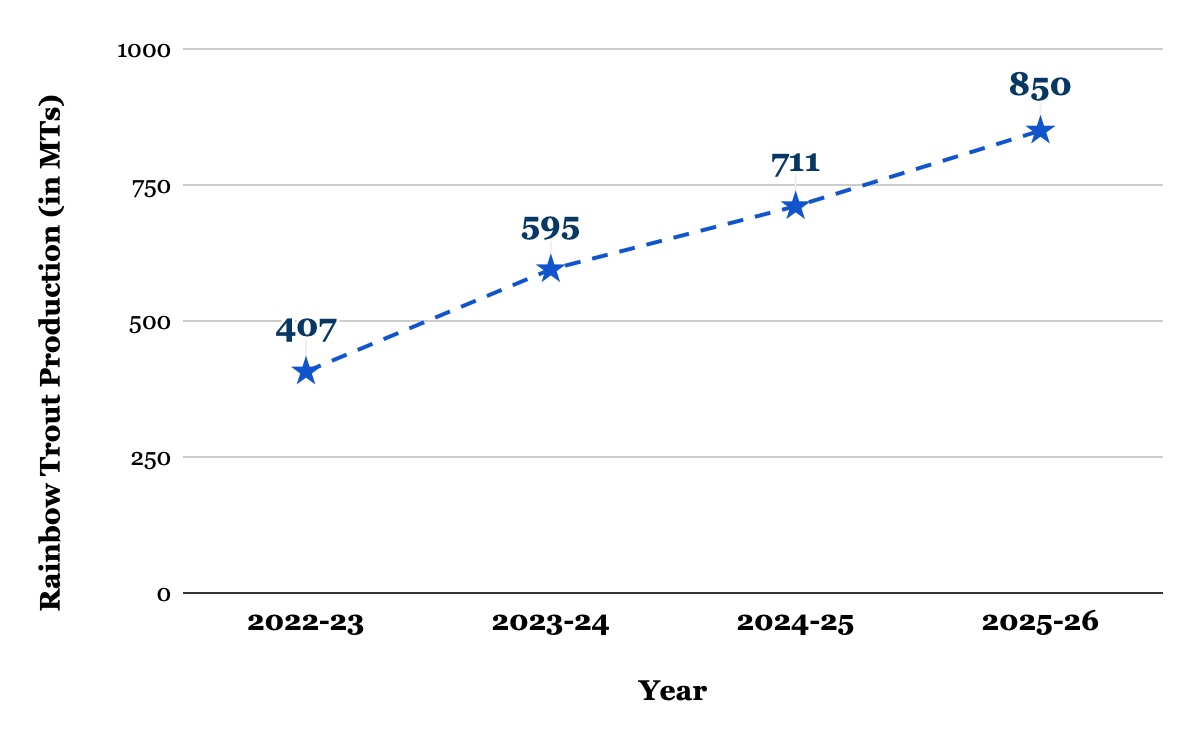
Nationally, trout production alone has increased significantly, rising to roughly 6,000 metric tonnes in 2024–25 around 1.8 times higher than a decade earlier.
What's harder to capture in a table, but visible on the ground, is who's entering the sector. Umed Singh's path, from a city job to a cooperative-backed trout unit to a family enterprise, is becoming a recognisable pattern: people with years of outside work experience, returning to set up units with departmental support.
We have been driving a broader market development push for the sector, spanning B2B, B2G, exports, and e-commerce integration, while helping build the state's capacity for value-added fisheries products to move it beyond its current local-demand base. The approach builds in sequence: local demand first, then B2G /local B2B with cafes, restaurants, and resorts, and eventually B2B markets further afield like Delhi, Bangalore, and Chandigarh as volumes justify it.
Our support to the department spans several fronts. One example is a prioritisation framework built to decide which export markets to enter and in what order: it weighs each candidate country on demand and consumption trends, market size, import dependency, and price patterns, mapped against the compliance complexity of entering that market, assessed product-variant by product-variant, so readiness can be built accordingly rather than assumed uniformly. It draws on FAO, UN trade data analysed at a global level, giving the department an evidence base for sequencing market entry rather than pursuing markets opportunistically. Alongside this, we assisted in strengthening review and monitoring through performance trackers, resolved day-to-day bottlenecks in export operations, and designed internal RFPs to bring more rigour to how the department procures and partners.
That groundwork paid off in June 2026, when Uttarakhand delivered its first-ever international fish consignment: 5 MT of Rainbow Trout worth ₹23 lakh, exported to Nepal with soft commitments in place for future shipments, flagged off by Saurabh Bahuguna, Minister for Animal Husbandry and Fisheries. We got involved end to end: identifying the buyer, leading negotiations, planning logistics, ensuring regulatory compliance, contracting, and managing stakeholders across the partner agencies involved. Read this way, the shipment is evidence that the sequence and the frameworks behind it are working, not a starting point for other producers to replicate prematurely.
Value addition ties the later stages together. The 5 processing units being set up across the state will let farmers convert raw fish into smoked, filleted, or frozen products with longer shelf life and better margins, the difference between a livelihood that survives and one that supports a family business into its second generation, the way Umed's has.
Fisheries alone won't reverse a migration problem this large. Education, healthcare, and connectivity remain the bigger structural drivers, and the recent decline in out-migration is still modest against decades of outflow. But Umed Singh's 20 raceways in Singhot show what's possible when a livelihood is deliberately built to fit the hills, backed by the kind of on-ground implementation support that turns a policy intent into a working system.


.png)