

India claims to have achieved 100% electrification, however the promise of universal access to electricity has not translated into reliable power supply. The promise of a fully connected nation continues to clash with localized grid fragility. An analysis reveals that unreliable power and persistent load-shedding could silently drain roughly 1.9% of India's GDP annually due to choked industrial output and the regressive cost of backup diesel generators. A survey of six of India’s most populous northern states found that rural households faced 11 hours of electricity outages on average every day. However, these numbers only tell a part of the story.
Every year, India's power utilities publish reams of data: megawatts generated, units distributed, transmission losses, complaint resolution rates. What none of these reports measure is what a power outage costs the person on the other end of the wire. SAIFI tells us how often the average consumer loses power. SAIDI tells us for how long. Neither metric asks what those hours were worth to the child who stopped studying, the clinic whose cold chain failed, the woman who did not step out because the street was dark.
In the last decade, India has built more schools than almost any country in the world. It has expanded its primary health network to cover nearly every district. It has launched some of the largest agricultural support programmes in history. The inputs are there.
Yet learning outcomes remain stubbornly low. Vaccine wastage rates in several regions exceed 30%. Post-harvest losses consume a significant share of farm income every season. The question that rarely gets asked: what do all these investments have in common? They all require power to function. And power, for millions of Indians, is not something they can count on.
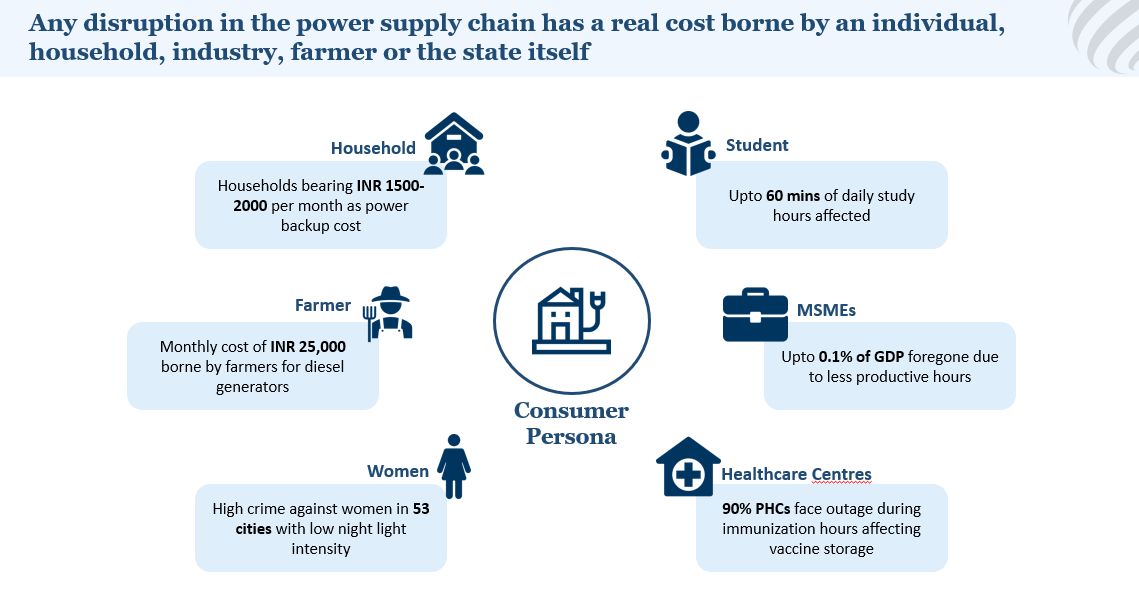
The evidence bears this out across every parameter we track for human development. Children in electrified households score measurably higher on reading assessments and study 30–60 additional minutes per day — with the largest effect in the foundational ages of five to eight. For MSMEs and informal workers, every outage hour is a direct deduction from daily output; improving supply reliability to 16 or more hours per day generates economic benefits estimated at 0.1% of GDP. Meanwhile, households without reliable grid supply spend ₹500–₹1,200 per month on backup alternatives at roughly three times the cost of grid power — a regressive coping tax that the poorest pay most.
The health system is perhaps the starkest case. One out of every two PHCs in the country suffers from unreliable power supply, with 90% reporting outages during peak immunisation hours. Moreover, more than 21% of the PHCs reported damage to medical equipment due to voltage fluctuations (CEEW). For women, reliable evening supply is not a comfort, it is a safety condition. A study across 53 Indian cities found a significant inverse relationship between night light intensity and crimes against women, with improving lighting producing measurable reductions in crime rates.
And then there is the fiscal dimension. Power outages impose three compounding burdens on state budgets — emergency procurement costs, billing and governance inefficiencies, and AT&C losses. When supply falls short, DISCOMs are forced into emergency procurement at 4-5 times the cost of scheduled grid power. Governance gaps in billing and subsidy administration, decisions made retrospectively rather than monitored continuously, allow inefficiencies to accumulate unchecked, inflating subsidy outgo beyond what the system intends to disburse. The cost of power unreliability, in other words, is not just borne by citizens. It is borne by the state itself, in ways that compound year after year.
Punjab offered the clearest possible case for GDi to solve for this issue: a state with genuine institutional capacity and reform intent, facing power sector challenges that were structural rather than accidental, and therefore solvable.
The scale of Punjab's structural challenge becomes clear in the numbers. The state's subsidy architecture rests on two large beneficiary groups: ~14 lakh agricultural pump-set connections receiving free electricity at a projected cost of ₹10,175 crore in FY 2024–25; and nearly 80 lakh domestic households receiving 300 free units per month at a projected cost of ₹8,785 crore in the same year, representing over 40% of PSPCL's own projected income for the year.
On fiscal health, PSPCL swung from a cumulative loss of ₹4,776 crore in March 2023 to a reported profit of ₹2,630 crore in FY 2024–25. However, service delivery remains a persistent challenge. The state recorded 12 lakh+ hours of power outage incidents. These outages continue to stifle economic growth, hinder public service delivery, and impact everyday life for Punjab’s citizens. A utility can balance its books while its consumers still sit in the dark. Punjab, in 2024–25, was doing exactly that.
Punjab had the infrastructure, the institutional capacity, and the ambition of a state that knows what it is capable of. What it lacked was the diagnostic rigour to identify where the system was failing and the implementation capacity to fix it systematically.That is where GDi came in.
The first step was diagnosis. Our work in Punjab showed that unreliable power is rarely the result of a single failure. It is the cumulative outcome of weaknesses across five interconnected layers - how power is sourced, what it costs, whether the network can deliver it reliably, how quickly the system responds when something fails, and whether the utility has the financial and governance capacity to sustain improvement.
A weakness at any one layer places pressure on the others. Cheaper power means little if an overloaded feeder repeatedly trips; stronger infrastructure does not guarantee reliability if faults take hours to locate; and operational improvements are difficult to sustain without the financial capacity to maintain the network. Improving reliability therefore requires looking at the power-delivery system as a whole.
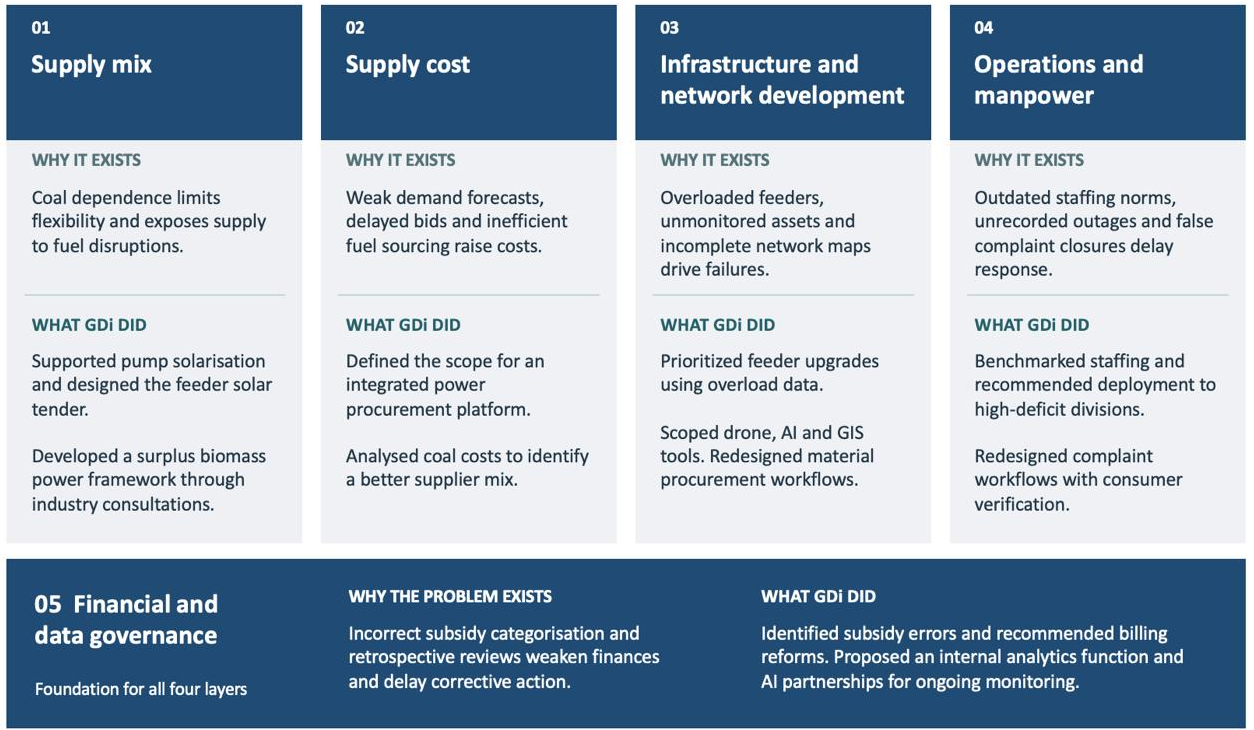
The five layers together explain why power-sector reform cannot be reduced to simply adding generation capacity or improving a DISCOM's finances. But from a consumer's perspective, two layers are particularly consequential: whether the physical network fails in the first place, and how quickly the utility responds when it does. In Punjab, these became two important areas of GDi's work with PSPCL.
Having enough power is not enough if the network carrying it to consumers is overloaded or prone to failure. In Punjab, overloaded feeders, limited visibility into asset condition, and gaps in network mapping made parts of the distribution system more vulnerable to outages.
Our work with PSPCL therefore focused on moving from reactive repair towards preventive maintenance. Feeder-level data is being used to identify infrastructure hotspots and prioritise investment where it can have the greatest reliability impact. Drone-based inspections and AI-enabled analysis are being explored to identify vulnerable assets before they fail, while GIS-based network mapping can provide field teams with better visibility into the distribution network.
At the same time, PSPCL’s material procurement process was streamlined to reduce the time required to make critical equipment available for maintenance and network augmentation.
No network can be completely failure-proof. Reliability therefore depends equally on how quickly the utility can identify a fault, deploy the right personnel and restore supply.
In Punjab, this meant addressing both manpower deployment and complaint resolution. Field workload and fault data were used to identify divisions facing the greatest manpower gaps and support more targeted deployment of newly recruited Assistant Linemen. At the same time, PSPCL’s complaint-resolution system is being redesigned to create a clearer chain from outage registration to verified restoration. Smarter complaint allocation, automated SLA tracking and consumer-validated closure can make outages more visible and accountability clearer. More importantly, the resulting data revealed patterns like repeated tripping, prolonged restoration times, recurring faults or “no fault found” cases, that individual complaint records often hide.
Together, the two approaches create a reinforcing cycle: better outage data helps identify network weaknesses; better diagnosis guides maintenance and manpower; and better-targeted action can reduce both the frequency and duration of outages.
Punjab is not a unique case. Its power sector challenges, high subsidy dependence, infrastructure under stress, slow fault response, revenue leakage, inadequate procurement rigour, are present, in varying combinations and degrees, in virtually every state in India. The names of the organisations change, the structural failure modes do not.
What Punjab offered was a context where all five layers of power sector failure were present simultaneously, and where institutional conditions were right to address them together. The framework that GDi built: diagnosing and intervening across supply mix, supply cost, network infrastructure, operational capacity, and financial governance, was not designed for Punjab specifically. It was designed for the problem. Punjab was where it was first applied.
The social cost of those failures, as this article has attempted to show, is not abstract. It is measured in study hours lost, in vaccine doses wasted, in irrigation cycles cut short, in MSME output foregone, and in subsidy rupees spent year after year to sustain a system that continues to underperform. Every state that has not systematically addressed its power delivery chain is paying this cost, and so are its citizens, silently, every evening the lights go out.
The question this blog leaves with every state government and leadership that reads it is a simple one: which of the five layers in your state is failing and what is it costing your citizens while it remains unaddressed?
GDi's work in Punjab is not complete. Good diagnostic work precedes good outcomes, but it does not guarantee them overnight. The interventions GDi designed in Punjab were built for durability, not for quick wins. The procurement platform will demonstrate its value across multiple market cycles. The infrastructure upgrade plan will prove its worth during the summer peak. The complaint resolution system will produce reliable performance data once it has accumulated enough clean records to establish a meaningful baseline. This blog presents what has been built and why it was built that way. The outcome data will follow, and when it does, Punjab will have something more valuable than a one-time improvement: a replicable, evidence-backed model for power sector transformation that every other state can learn from. What replicating this model requires is not a new methodology, it is a counterpart willing to ask the same question Punjab asked, and committed to acting on the answer.


.png)