

It's June again, and Ram Singh, a farmer from Bathinda, is irrigating his fields for the paddy plantation. The crop cycle is the same one he's followed for years, and the weather is much like before, just a little more humid, with a sharper heatwave this time, made worse by a Super El-Niño. But something has changed: the flow of water from his agricultural pump.
This isn't a problem Ram Singh is facing alone. There are 13 lakhs electricity pumps in Punjab and almost 75% of them have been grappling with it for the last couple of years. We're talking about the groundwater crisis in one of India's most prominent agricultural states. Most of us are aware the problem exists. Far fewer know what actually led us here.
This might look like today's problem, but its roots go back to the Green Revolution. What began in the 1960s as a subsidy on electricity, meant to push farmers toward adopting pumps and boosting agricultural production, turned in 1997 into something else entirely: a political incentive, offered as free electricity to win farmer votes.
If you come from a farming family, you'd know irrigation is not an easy task. It means constantly checking water flow, monitoring field-level water, redirecting it as needed, and spending entire days and nights in the field just to make sure the pump runs only as much as necessary, mostly to keep the electricity bill in check. But what happens when there's no bill to check? Convenience takes over. The pump keeps running for hours, long after the field's water needs are met, with no one watching and no reason to stop.
That's roughly what happened in Punjab. Free electricity, meant to ease the farmer's financial burden, ended up creating a much larger problem: a groundwater crisis. And by now, it's so deeply woven into the system that out of 153 blocks, 115 are in the dark zone and facing a severe groundwater crisis & no government wants to risk upsetting farmers by taking the benefit away.
So here's where it gets tricky. You can't simply switch off a benefit that's been around for nearly three decades. For most farmers, this isn't a perk; it's an entitlement their entire farming economics is built around. Any government that tries to touch it risks a backlash large enough to make the idea a non-starter.
But there's another number that makes the problem impossible to ignore. This "free" electricity isn't actually free, someone is paying for every unit pumped out. That someone is the state government, and the bill currently runs to nearly ₹10,000 crore a year. So, Punjab finds itself paying a massive annual subsidy to sustain a system that's simultaneously draining its groundwater table, year after year, pushing several blocks deeper into "over-exploited" territory.
You can't take away free electricity. But what if you could make farmers want to use less of it, on their own?
That's the question we, along with Punjab Energy Development Agency (PEDA) and the Punjab State Power Corporation Limited (PSPCL), set out to answer. Our answer is a pilot project called Individual Pump Solarisation, or IPS.
The idea, once you strip away the technical jargon, is fairly simple. Take a farmer's existing pump, fit it with solar panels, and swap in a more energy-efficient pump set. The farmer pays just 10% of the cost, the remaining 90% is funded by the state and central government through a scheme called PM-KUSUM.
During the day, the pump now draws power from the sun instead of the grid. The farmer hasn't lost anything, grid electricity is still available as backup whenever needed. But here's the part that changes the math entirely: whatever solar power the farmer generates and doesn't use gets exported straight back to the grid, and PSPCL pays for it, ₹2.5 per unit for the first five years, ₹2 per unit for the next twenty.
For the first time, a farmer's pump isn't just something that costs money to run. It's something that can earn money too.
And the earnings only go up when the pumping goes down. Use less, save more groundwater, export more solar power, take home more money. The same instinct that made farmers run their pumps freely when electricity cost nothing now works in the opposite direction, because conserving power finally has a rupee value attached to it.
To make this real for farmers on the ground, we went beyond simply providing the technology. We conducted awareness campaigns, workshops and door-to-door outreach to explain the link between pumping, groundwater conservation and farmer income. We also introduced a mobile app that lets farmers track exactly how much solar power they are generating versus consuming, in real time. This data is then monitored to identify usage patterns and followed up with farmers, making the shift to lower pumping and higher solar export an informed, continuous behaviour change rather than a one-time intervention.
Right now, 25 farmers have been onboarded on the Pirkot feeder in Bathinda district, the first of three feeders identified for the pilot, with alternate sites being worked out for the remaining two. The eventual target is 200 farmers.
Together, these 25 farmers have generated 2.6 lakh kWh of solar energy and earned ₹3.1 lakh in payouts so far.
It's a small number against the scale of Punjab's groundwater crisis. But that was never the point of this pilot. The point was to test something far more fundamental: whether putting a price on conservation actually changes how a farmer like Ram Singh decides to run his pump. And whether farmers can increasingly use solar energy as an alternate source of power for their agricultural needs.
And the early numbers are encouraging. Through 2024 and 2025, Pirkot's pumping load moved in step with comparable agricultural feeders, following the same seasonal rhythm. Since the pilot went live in January 2026, that has changed. In February, Pirkot drew roughly 75,000 kWh against about 1.3 lakh kWh on its peers. In March, it was about a third of what comparable feeders drew. In May, as the paddy season ramped up, it sat near 85,000 kWh while most peers were close to 2 lakh. Same seasons, same crops, same kind of feeders. Only Pirkot bent away from the pattern.
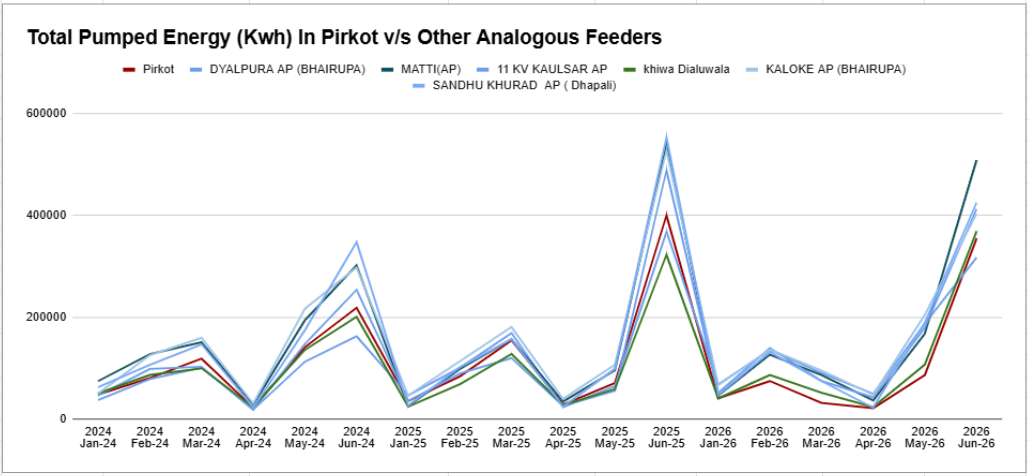
If the early signs continue holding up, the implications stretch well beyond these 25 farmers. PEDA estimates that scaling this model to roughly 2 lakh pumps across the state could save the government tens of thousands of crores in subsidy outflow over the next 25 years, while easing the pressure on a groundwater table that's been falling for decades.
Back in Bathinda, Ram Singh's pump is still humming. But the question is no longer only how long it runs. It's also what that running earns him.
What comes next is easy to describe: we will complete our target of 200 farmers across the three feeders, and then let the data do the talking. How much less do these farmers pump? How much more solar do they export? Does the payout actually change the way they think about every hour of running the motor? If the answers hold up across 200 fields and not just 25, we will have something Punjab has never had before: evidence to decide whether a state-wide policy is possible.
Working on this pilot has left me with two lessons that go beyond solar panels.
First, behaviour-change policy needs a beneficiary who gains from the new equilibrium, not just one who is compensated for giving something up. For decades, the conversation around free electricity has been about what farmers would lose if it went away. IPS asks a different question: what can they gain if they use less? A farmer who is merely compensated for pumping less will always feel that something has been taken from him. A farmer who earns more by pumping less has a reason to guard the new arrangement himself. That, more than any subsidy or penalty, is the art of policy design.
Second, early results are only the beginning. The first few months, much like a feeder-level analysis, show promising numbers. The real test comes in the kharif season, when paddy demands water, habits pull one way and incentives pull the other. Human behaviour is not homogeneous. Some farmers will respond to the rupee signal immediately, some will need a nudge, and some will need to see their neighbour's payout before they believe it. Understanding these different patterns, and not assuming one farmer represents all, is the next step to refining the programme design before we scale up.
Ram Singh's story is still being written. If the pilot holds, the next chapter won't be about a pump that drains a state's water table. It will be about a pump that helped save it, and paid its owner for doing so.


.png)