

Jammu & Kashmir produces nearly a fifth of India's wool, yet most of it leaves the region raw, unprocessed, and worth very little to the farmers who shear it. When I joined GDi Partners as an Associate Consultant last July, this was one of my first problem statements on the Holistic Agriculture Development Programme: why were farmer incomes from wool collapsing so sharply?
Coming from an Engineering background, my instinct was to go data-heavy first. You learn to trust numbers, sensor outputs, and sample distributions over hunches or anecdotes. When a system breaks, you measure it. My plan was simple: pull wool price trends across states, compare J&K's numbers against the national average, find where the decline started, and work backward from there, the same way you'd debug a production line that had stopped performing.
The price data confirmed the decline, and it also gave me a timeline, a specific point where farm-gate prices dropped off. Once close to ₹100/kg, prices had collapsed to ₹20-50/kg, some as low as ₹10-15/kg. That timeline pointed me toward policy history, and that's where I found the actual event: the J&K Sheep & Sheep Products Development Board, which had once offered farmers a purchase channel and price support, had shut down in 2021, right around when the drop began. On paper, that was a clean, complete answer, one institution gone, one price crash, cause and effect.
The Answer That Didn’t Quite Add Up
If that was the whole story, I expected the fix to be equally simple, reconnect farmers to buyers, and prices would recover. So I checked whether that had already been tried. It had. The department had already tried connecting farmers to private buyers. But those efforts had stalled. Not on price, on quality. That didn't fit. If the Board's absence explained everything, price should have been the sticking point, not quality.
I didn't have an answer for that gap, and I could have just kept digging through more data to find one. Instead, in one of our problem-solving sessions, I walked the team through where I'd gotten stuck, and a senior person from the team flagged it right away. Why don't you go out to the field, he said, and actually talk to some farmers, hear the problem from their side?
So I went to a Sheep Extension Centre, one of the government's local outposts where farmers actually go for veterinary support, shearing help, and general advice on their flocks, the closest thing to a front line the department has. I asked a supervisor there what was actually going wrong with the wool itself. I was expecting something about handling, or storage, maybe. Instead he told me about the sheep.
These farmers move with their flocks as the seasons change. In peak summer, a sheep that hasn't been sheared gets miserable, restless, and struggles in the heat. So the farmer shears it. Not because it's the right time for the wool, but because the animal needs relief and he's not going to make it wait.
What nobody had explained to the farmers was the financial consequence: premature shearing yields short staple length. Combined with dirt accumulated during transit, the wool becomes unspinneable for commercial mills, forcing buyers to reject it or buy it at scrap value for low-grade industrial felt.
No dataset I'd pulled was ever going to hand me that. I hadn't known to look for it
Putting the Pieces Together
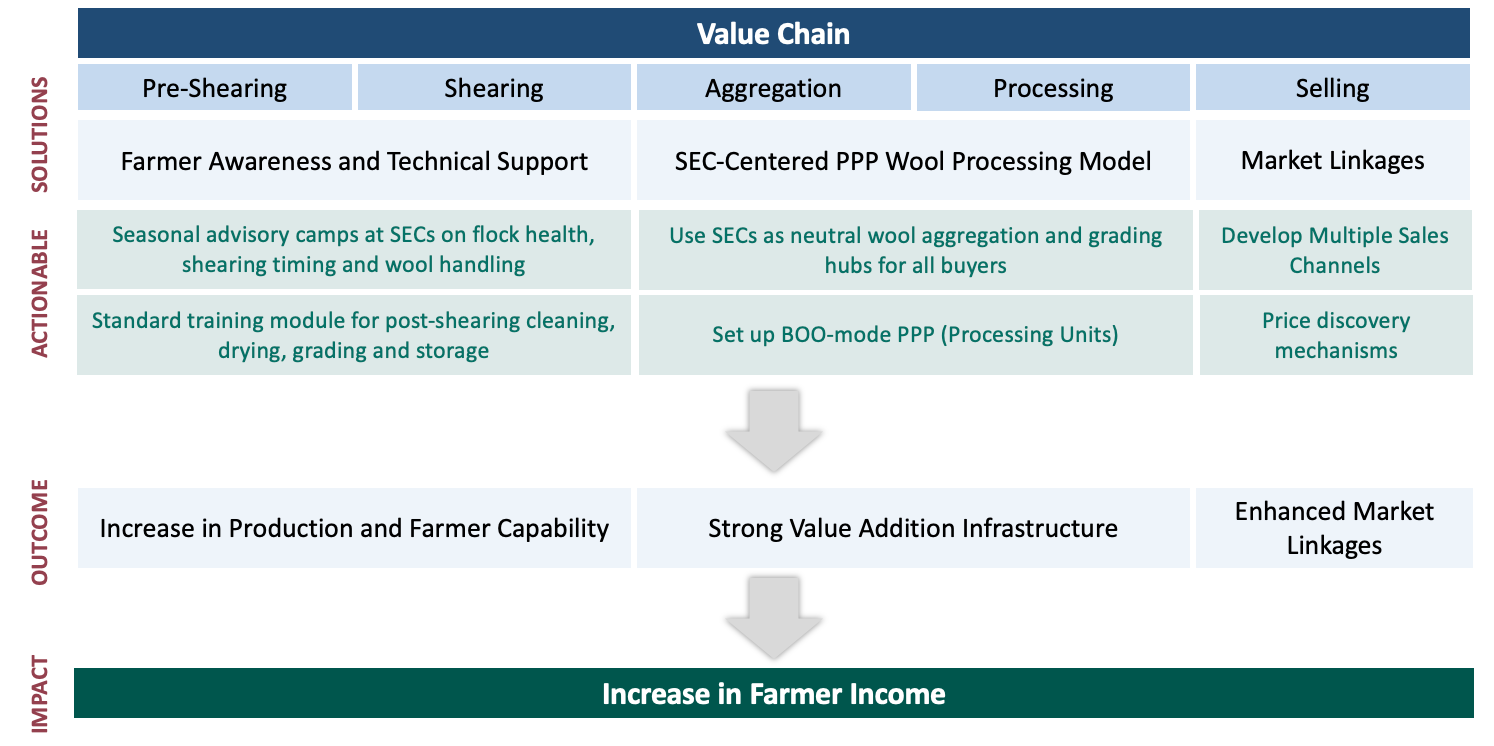
By this point I had three things in front of me: what the data and policy history told me, what the SEC visit had shown me about the sheep and the shearing, and a map of exactly where value was leaking, and why, at each point it happened. Now I had to turn all of that into something that could actually be acted on or as we consultants say a “Framework” of sorts.
Every fault pointed to a different fix, so I went stage by stage rather than hunting for one fix to cover all of it. Farmers needed to know what the supervisor had just told me, when to shear, how, and how to handle wool right after. Aggregation and processing needed the piece that disappeared when the Board shut down, somewhere to collect scattered wool and turn it into something a buyer actually wanted. Selling needed a market that paid for quality instead of whatever a trader offered that day.
For the collection and processing piece, the instinct is usually to build the missing part from scratch. But the Sheep Extension Centres were still standing, still trusted, still where farmers already went. Replacing something that's working isn't a fix, it's a waste. The actual gap was narrower than it first looked, just the processing step itself. So the centres kept doing what they already did well, collecting wool, and a private partner came in to run the processing side of things
Coming from an engineering background, I'd assumed problem-solving was mostly about data, structured thinking, root cause analysis, finding the variable that moved and trace it back. That conversation at the SEC showed me impact consulting asks for something more than that. Breaking a problem down on paper and understanding how it actually plays out on the ground turned out to be two different things. Structured thinking still matters, it's still where I start, and it still defines the edges of a problem. But validating with data alone isn't enough. You also need the human lens, the anecdotal, lived experience of the people the problem actually belongs to, because that's often where the real "why" is sitting.
A Story Still Unfolding
If you've been following so far and expecting some big outcome at the end, a scheme launched or a policy signed, sorry to disappoint. That's actually my second learning.
Even when you have the full picture, root cause, framework, and every piece of the analysis done properly, a problem still might not get picked up. Not because it was wrong, but because of priorities that have nothing to do with how good the work was.
That's where the role of a knowledge partner sits. The job isn't to guarantee something gets implemented tomorrow, it's to keep bringing new, thoughtful solutions to the government so that when the timing does align, there's already a real answer sitting there. Some of it moves fast, some of it takes years. That's what matters, not whether it happens immediately, but that it eventually does.


.png)